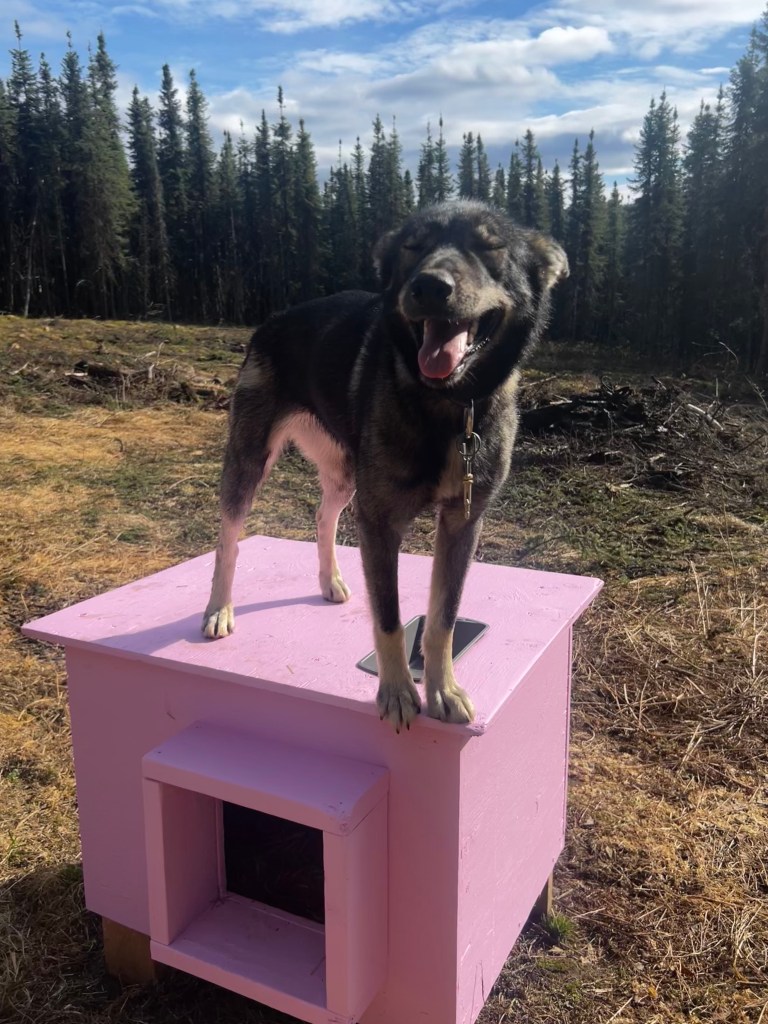
Sam finally moved back home to Fairbanks after finishing her rookie Iditarod. Lately she's been sitting in a recliner. A fully unemployed bum, she is. But that's just fine. This is the first time she's been unemployed as a "dog handler" since 2019 -- that's six years of scooping dog poop for other people. Now she's home, hanging out with friends, drinking beer, going on long walks with the dogs, sleeping in, and waiting for the snow to melt so she can start planting a garden.

Meanwhile, Tucker sat on his butt all winter, just picking his nose and waiting for Sam to come home. At one point in February he did get off of his butt to ski 150 miles on the Yukon River and then again to ski the Iditarod Trail Invitational 350. But now, this spring, it's time for him to go back to work fighting wildfire in Alaska. He'll be picking up a lot of sticks in the woods and sleeping on the ground for most of the summer. Every now and then he'll get a couple of days off at home to unnecessarily critique the garden and ask why the dog yard fence hasn't been put up yet.

Over the spring/summer of 2025, we (mainly Sam) will keep working on the kennel: building a dog barn, putting up fences, acquiring dog gear, and getting ahold of some more dogs. Our old boss and mentor, Ryne Olson, will be donating 8 dogs to us (to see which dogs will be joining us click on the "meet the dogs" tab). Thanks Ryne! That'll put us at 11 dogs that can run/race in harness this coming fall. Puppy fever is in the air, but don't hold your breath, alright? Big plans here, big plans. Future's looking good, lots of dog poop to scoop out there on that horizon, but we'll be doing it for ourselves.
Here follows a rough guide on how to create, cultivate, and utilize your own personal, historically authentic sourdough starter as taught to me by my mother, as taught to her by her mother, and so on.
Author’s Note: As far as I’m aware, there are no official pronouns for yeast yet so “they” and “it” used interchangeably will have to do.
First, get a Great Uncle Sven (or Ovid or Bartholomew or Edna or whatever ethnic background you desire your great uncle or aunt to be). When your great uncle dies in the height of the Yukon Gold Rush during a blizzard, make sure someone in history saves the sourdough starter from his armpit, where of course, he was keeping it safe and warm. Now your sourdough has its flavor.
Next, go out and acquire your great uncle’s sourdough starter from a friend, neighbor, local bakery, or even, God forbid, The Internet. Other than already having a familial history, whatever starter you acquire will truly become yours because once you set that baby out in the open (uncovered by the stove or heater) dandruff, spit, and microbial ecosystems riding on dust motes that are specific to your abode will get into it. Your dog will give it a couple of licks, maybe the cat will sneeze in it, maybe a mouse will drown in it and you’ll feel just awful — this is good, though. All of this interesting activity will give your sourdough yeast a unique set of genetics they couldn’t acquire otherwise; it will make it hardy.
Why does your sourdough need to be hardy?
Your sourdough needs to be dang hardy because inevitably you will forget about it. And in the back of the fridge, while you’re on vacation or mowing the lawn, it will be forced to wage a brutal war against some form of evil, universal fungus. Yeast make bread and beer, not war, and in the end they will always lose this fight. So, when you discover your starter again it will smell and look dead, and you will feel the disdain of your great uncle weighing on your shoulders.
All hope is not lost.
When faced with destruction, the sourdough yeast will send some reserve members to the bottom of the jar. Your mission is to rescue them. So, hold your breath and pour/scrape the top layer of pond-scum off into the trash or down the drain. Then another layer. Then again. The goal is to get just a few uncontaminated yeast, and if you just plunge a spoon down in there you’re basically helping the enemy break through the lines. You’ll have to make sacrifices. Such is war.
Now, your rescued yeast will be in a state of duress and dormancy. Plop them in a bowl with flour and water, give them a warm place to rest, apologize to them, be patient, and they will recover. This may take a few days (the key is constant warmth — 65 degrees or warmer seems to work best. And don’t feed them wheat flour, they don’t like that). If your starter is taking a long time to grow but there are legitimate signs of life (bubbles and it smells like a foot), transfer a liberal spoonful of it to another bowl and give it fresh water and flour. Add a little sugar, too. When a yeast is unhappy it pumps out a bunch of stress signals and gunk that communicates to all the other yeast: “Batten up the hatches! The war ain’t over yet!” Changing the water and flour is a good cleansing technique to create a happier, faster growing, yeast community. Also, you gotta use a wooden spoon or stirring stick for all this work. Metals can inhibit yeast growth. Ultimately, yeast have fitness and emotions, the more you let them exercise, the stronger and happier they will be.
Taking good care of a bunch of single-cell, eukaryotic, microorganisms is just a lot of biology and chemistry but it doesn’t have to be cold science. People like to compare sourdough starters to plants: water it, feed it and it’ll grow. But what plant gives you a fruit every day, percolates right before your eyes, and has as much sass? If you live alone in a cabin and your sourdough starter sits out on a regular basis, I’ll tell ya, it has an aura that’s a lot cooler than a dumb plant. You should cultivate a healthy relationship with your starter. That requires two-way communication. You’ll end up talking to it, watch.
Alright, now that you can manage to keep your starter alive and healthy, you’re all set to make waffles, pancakes, or bread. This all starts the night before.
So, flour and water the night before, you’ll figure out how much of each by trial and error. I ain’t here to hold your hand all the way, alright?
Leave it to perk by the heater and tell it: Grow, grow, grow!
In the morning, before you do anything else, put some sourdough back into the peanut butter jar you’ve been keeping your starter in (personally, I keep two jars of sourdough starter in the fridge for when I inevitably forget this step). Your starter jar should have at least one hole punched in the lid so that the yeast can breathe better. Yeast can actually live and grow in anaerobic environments but they won’t be as happy.
Pancakes/Waffles:
Start by cooking bacon. While that’s sizzling, add an egg to the sourdough, pour in some sugar, and add some salt.
Once the bacon is cooked, dissolve just a little bit (just a little bit now, ya hear) of baking soda in some water — how much b-soda you add will determine how soupy your sourdough mix is. Stir in the baking soda soup to your sourdough. But no more stirring than that! Leave it alone for chrissakes. Let it sit there a second while you flip your bacon.
If you’re making waffles, add bacon grease to the sourdough mix.
Begin the waffles or pancakes.
Start making eggs at the same time.
Somewhere in here the tale of Great Uncle Sven should probably be told, or at least acknowledged.
Don’t sin by using cheap syrup.
Give yourself a letter grade on how well you’ve done and make sure you announce it to any company that might be present. Announce it to the dogs on the couch if that’s who you got. If the smoke detector didn’t go off during this entire process that’s actually pretty impressive and you should up your letter grade by at least one letter or a plus.
Bread:
Go buy a 25lb bag of flour at Costco for $9 — you just saved yourself a million dollars in sourdough bread.
Wake your starter up the night before, and if you’ve been making at least one loaf of bread a week, it will be nice and thick and smelly by morning. Don’t forget to save some starter!
Add a little oil, some salt, bunch a flour. Knead that bad boy. Let it rise on the counter for a little while. Plunk it into the oven at whatever temperature you think should work. I don’t know, like 400 something. Check on it here. Check on it there. Set a timer if you’re that kind of kid. Take it out when you think it’s good. BOOM: loaf of bread. You’ll figure out what works best for you. Of course there’s lots of nuances in here but that’s for you to figure out. Don’t be intimidated, it’s OK. You got 25lbs of freakin flour to use up. Each day is a new experiment — that’s half the fun.
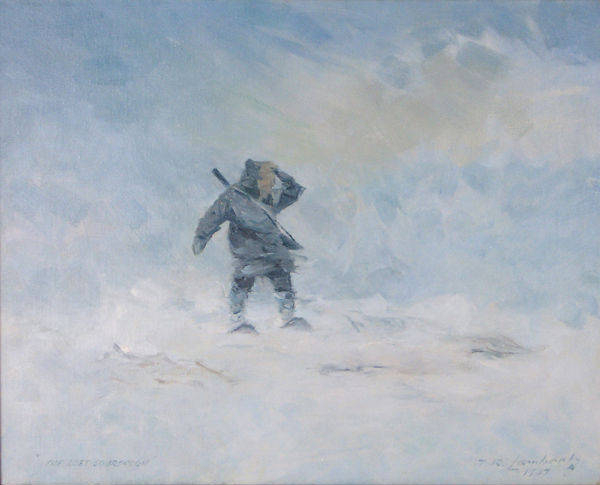
There is a painting of my great uncle Sven in the University of Alaska Fairbanks Museum of the North. In this painting, Sven’s about to die in a blizzard and nobody knows it’s him but us.
It was a rare day off from work that Sam and I were wandering around the UAF museum. A cold but bright winter day, the Alaska Range was out on the horizon to the south, acting as an exhibit itself. From the campus on the hill it was a hard view to give up for a quiet, gray oil painting. But I found myself rooted in front of “The Lost Sourdough” by Theodore R. Lambert, and when Sam came to join me I began to tell her a story.
“That’s my great uncle Sven,” I said, pointing at the painting. “That’s my great uncle Sven and the family’s lost sourdough. Look at the title. It has to be. The family sourdough is in his armpit.”
How could I explain? This was a story framed in senses: told within tastes, smells, and tones among dust motes of late morning light. A story that had always been immersed within the scene of a sourdough pancake breakfast at grandma and grandpa’s house.
“Tucker,” my grandfather would rumble, “that sourdough pancake you’re eating this morning, don’t you know its story?” He would take a big pause, a swig of coffee.
“Well, during the Klondike Gold Rush your great uncle Sven was going up and over Chilkoot Pass in the Yukon. But a storm came in and caught him, and he was lost. When they eventually found his frozen body, the first thing anyone said was, ‘Quick! Check his armpit,’ because that’s where they kept their sourdough starters in those days — to keep the yeast warm and alive. So they creaked open Sven’s stiff arm — criiiiiiick — and I’ll be damned if the starter wasn’t still good! HA! And that’s the same yeast that started the sourdough pancake you’re eating this morning.”
“Now that is just such a load of horseshit,” you might be inclined to say, and you could very well be right — my cornered family members of weaker faith might admit this after a fight. But I am not alone in whole-heartedly believing Sven’s story. Since I was a toddler I’d ceremoniously nodded along with the breakfast table congregation as my great uncle’s fate unfolded to bring me my pancakes.
It is no matter that this tale might have originally been stolen and adapted by my great-grandfather, who heard it from a mountain man in the Montana wilderness circa 1900. And it’s no matter that the “family” sourdough starter has allegedly been lost or perished several times in this decade alone. What matters is that it’s always reborn to its authentic self by the christening ritual of Sven’s story.
In Alaska, the “Sourdough” name has maybe been overworked. Gas stations, coffee shops, and outfitters have taken on a crest originally reserved for pioneers who had weathered several winters in the far north — people who kept sourdough starter in their armpits and so begot the title.
When Sam and I were workshopping names for a kennel, we liked the names of places that told stories, however small. There’s Deadhorse, Coldfoot, Tenderfoot, Lost Horse… So how could we resist a name that’s a pun on bread and tells a story? It’s a name that represents a personal, familial, and local connection. Most importantly, it’s a name that brings us great humor.
And how about the painting itself:
A lone, gun-slung figure being beat to hell by blunt wind. Sven’s raised a mittened hand to his parka’s ruff. He gazes off into the inevitable gray as the wind strips the paint right off him. Soon, it seems, he will be erased. To the untold eye this is the end of a story. But to us, the family’s sourdough starter is right there, tucked within the fold of Sven’s armpit, and that’s just the beginning of our day.