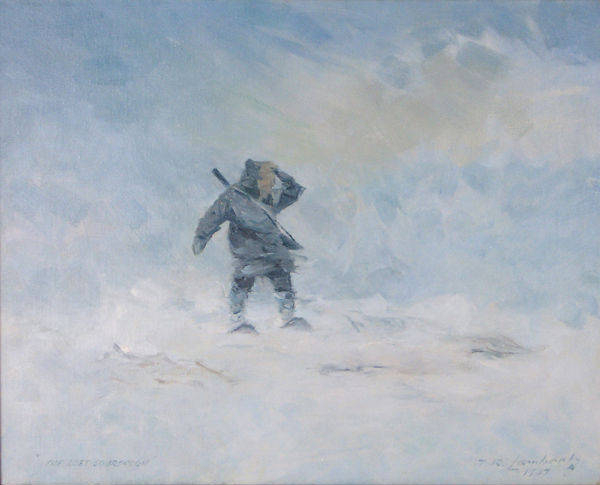
There is a painting of my great uncle Sven in the University of Alaska Fairbanks Museum of the North. In this painting, Sven’s about to die in a blizzard and nobody knows it’s him but us.
It was a rare day off from work that Sam and I were wandering around the UAF museum. A cold but bright winter day, the Alaska Range was out on the horizon to the south, acting as an exhibit itself. From the campus on the hill it was a hard view to give up for a quiet, gray oil painting. But I found myself rooted in front of “The Lost Sourdough” by Theodore R. Lambert, and when Sam came to join me I began to tell her a story.
“That’s my great uncle Sven,” I said, pointing at the painting. “That’s my great uncle Sven and the family’s lost sourdough. Look at the title. It has to be. The family sourdough is in his armpit.”
How could I explain? This was a story framed in senses: told within tastes, smells, and tones among dust motes of late morning light. A story that had always been immersed within the scene of a sourdough pancake breakfast at grandma and grandpa’s house.
“Tucker,” my grandfather would rumble, “that sourdough pancake you’re eating this morning, don’t you know its story?” He would take a big pause, a swig of coffee.
“Well, during the Klondike Gold Rush your great uncle Sven was going up and over Chilkoot Pass in the Yukon. But a storm came in and caught him, and he was lost. When they eventually found his frozen body, the first thing anyone said was, ‘Quick! Check his armpit,’ because that’s where they kept their sourdough starters in those days — to keep the yeast warm and alive. So they creaked open Sven’s stiff arm — criiiiiiick — and I’ll be damned if the starter wasn’t still good! HA! And that’s the same yeast that started the sourdough pancake you’re eating this morning.”
“Now that is just such a load of horseshit,” you might be inclined to say, and you could very well be right — my cornered family members of weaker faith might admit this after a fight. But I am not alone in whole-heartedly believing Sven’s story. Since I was a toddler I’d ceremoniously nodded along with the breakfast table congregation as my great uncle’s fate unfolded to bring me my pancakes.
It is no matter that this tale might have originally been stolen and adapted by my great-grandfather, who heard it from a mountain man in the Montana wilderness circa 1900. And it’s no matter that the “family” sourdough starter has allegedly been lost or perished several times in this decade alone. What matters is that it’s always reborn to its authentic self by the christening ritual of Sven’s story.
In Alaska, the “Sourdough” name has maybe been overworked. Gas stations, coffee shops, and outfitters have taken on a crest originally reserved for pioneers who had weathered several winters in the far north — people who kept sourdough starter in their armpits and so begot the title.
When Sam and I were workshopping names for a kennel, we liked the names of places that told stories, however small. There’s Deadhorse, Coldfoot, Tenderfoot, Lost Horse… So how could we resist a name that’s a pun on bread and tells a story? It’s a name that represents a personal, familial, and local connection. Most importantly, it’s a name that brings us great humor.
And how about the painting itself:
A lone, gun-slung figure being beat to hell by blunt wind. Sven’s raised a mittened hand to his parka’s ruff. He gazes off into the inevitable gray as the wind strips the paint right off him. Soon, it seems, he will be erased. To the untold eye this is the end of a story. But to us, the family’s sourdough starter is right there, tucked within the fold of Sven’s armpit, and that’s just the beginning of our day.